(And How to Stay Capable, Useful, and Independent Into Your 70s)
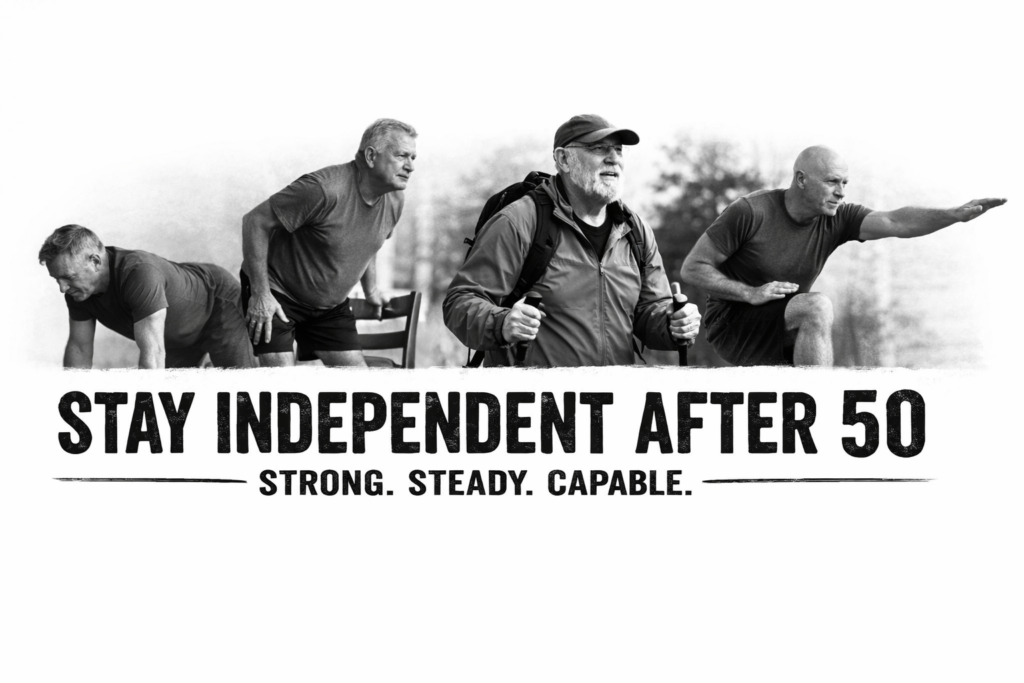
There’s one thing every man over 50 wants to hold onto as long as possible:
Independence.
Not money. Not status. Not looking young.
Independence.
Being able to move on your own. Carry your own weight. Take care of your home. Walk without fear of falling. Live without needing someone to help you out of a chair.
But here’s the truth most men don’t want to say out loud:
Pain steals independence long before age does.
Back pain. Weak legs. Stiff hips. Bad balance. Low energy.
These five problems creep in slowly… then suddenly you’re avoiding stairs, skipping walks, holding onto railings, or telling yourself “I’m just getting older.”
You’re not “getting older.” You’re getting weaker in specific places — and those places can often be fixed.
This guide shows you how.
Everything here is free, simple, and built for men on a fixed income. No gym. No equipment. No nonsense.
Let’s get your independence back.
PAIN #1: Back Pain — The #1 Independence Killer
Back pain is the first domino. Once your back hurts, everything else falls apart:
- You move less
- Your legs weaken
- Your hips tighten
- Your balance drops
- Your confidence disappears
Here’s what actually helps.
1. The Cat–Camel Reset (1 minute)
This resets the spine and reduces stiffness.
How to do it:
- Get on hands and knees
- Arch your back up like a cat
- Then slowly drop your belly down
- Move gently, don’t force anything
Do 10 slow reps.
2. The Hip Hinge Fix (30 seconds)
Most back pain comes from bending wrong.
How to do it:
- Stand tall
- Push your hips back like you’re closing a car door with your butt
- Keep your back straight
- Return to standing
This teaches your body to bend without crushing your spine.
Do 10 reps.
3. Glute Activation (1 minute)
Weak glutes = overworked back.
How to do it:
- Lie on your back
- Knees bent
- Lift your hips into a bridge
- Squeeze your butt at the top
Hold 2 seconds. Do 10 reps.
PAIN #2: Weak Legs — The Silent Fall Risk
Men don’t notice their legs getting weak until it’s too late.
Weak legs = poor balance = falls. Falls = hospital → rehab → loss of independence.
Here’s how to rebuild leg strength at home.
1. The Chair Stand Test
This tells you where you stand.
How to do it:
- Sit in a chair
- Stand up without using your hands
- Sit back down
If this is hard, your legs are weaker than you think.
2. Chair Stands (1–2 minutes)
The single best leg exercise for older men.
How to do it:
- Sit
- Stand
- Sit
- Repeat
Do 10–15 reps.
3. Wall Sits (30–45 seconds)
Builds strength fast.
How to do it:
- Lean against a wall
- Slide down until your thighs are working
- Hold
Start with 20 seconds. Work up to 45.
4. Step‑Ups (1 minute)
Strength + balance in one move.
How to do it:
- Use a step or sturdy box
- Step up
- Step down
- Switch legs
Do 10 each leg.
PAIN #3: Stiff Hips — The Reason Men Start Walking Like They’re 80
Stiff hips shorten your stride. Short stride → shuffling → poor balance → falls.
Fixing hip stiffness is one of the fastest ways to feel younger.
1. The Hip Flexor Stretch (1 minute each side)
How to do it:
- Stand with one foot forward, one back
- Bend the front knee
- Push your hips forward
- You’ll feel the stretch in the front of your back leg
Hold 30–60 seconds.
2. The “Long Stride Reset” (30 seconds)
This retrains your walking pattern.
How to do it:
- Take slow, exaggerated long steps
- Swing your arms
- Keep your chest tall
Do this for 30–45 seconds before walks.
3. The 90/90 Hip Opener (1 minute)
How to do it:
- Sit on the floor
- Front leg bent at 90°
- Back leg bent at 90°
- Lean forward gently
Switch sides.
PAIN #4: Poor Balance — The Problem Men Ignore Until It’s Too Late
Balance drops FAST after 50. Most men don’t notice until they start grabbing railings.
Here’s how to rebuild it.
1. The Kitchen Counter Drill (1 minute)
How to do it:
- Stand next to a counter
- Lift one foot
- Hold for 10–20 seconds
- Switch legs
If you wobble, good — that’s your balance system waking up.
2. Heel‑to‑Toe Walk (1 minute)
How to do it:
- Walk in a straight line
- Heel touches the toe each step
- Slow and controlled
This trains your inner ear and stabilizers.
3. Single‑Leg Reach (1 minute)
How to do it:
- Stand on one leg
- Reach forward with the opposite hand
- Return to standing
Do 5 each side.
PAIN #5: Low Energy — The “I Just Don’t Feel Like Myself Anymore” Problem
Low energy makes everything harder. It kills motivation, strength, and independence.
Here’s how to fix it cheaply.
1. Hydration + Electrolytes (cheap version)
Most older men are dehydrated.
Cheap fix:
- 1 glass of water
- Pinch of salt
- Squeeze of lemon
Energy goes up fast.
2. The 10‑Minute Morning Mobility Loop
This wakes up your joints and nervous system.
Do this every morning:
- 2 minutes back mobility
- 2 minutes hip mobility
- 3 minutes balance
- 3 minutes leg strength
You’ll feel younger by the end of the week.
3. Cheap Protein Sources
Protein = strength = independence.
Best low‑income options:
- Eggs
- Canned tuna
- Beans
- Peanut butter
- Cottage cheese
4. The 10‑Minute Walk
The simplest energy booster on earth.
Walk slow. Walk tall. Walk every day.
THE FIXED‑INCOME ADVANTAGE
Here’s the part most men don’t realize:
Staying independent doesn’t cost money. It costs movement.
You don’t need a gym. You don’t need supplements. You don’t need fancy equipment.
You need consistency.
THE 10‑MINUTE DAILY INDEPENDENCE ROUTINE
Do this once a day:
- 10 chair stands
- 10 hip hinges
- 10 cat–camel reps
- 30‑second wall sit
- 30‑second balance hold each leg
- 10 long‑stride steps
- 10‑minute walk (optional but powerful)
This routine keeps you strong, mobile, and independent.
CLOSING: Independence Is Earned One Small Habit at a Time
You don’t have to accept the slow slide into weakness. You don’t have to shuffle, struggle, or stiffen up. You don’t have to lose your independence.
Fix these five pains and you stay capable, useful, and steady well into your 70s.
Start today. Start small. Start with 10 minutes.
Your future self will thank you.
Disclaimer
This content is for general information only. It’s not medical advice, and it’s not a substitute for talking with a qualified health professional.