Hip flexor pain hits men differently after 40. You’re not “injured.” You’re tight, weak, overworked, and compensating — usually all at once.
And here’s the part most men never hear:
Your hip flexors aren’t the real problem. They’re the warning light.
This guide breaks down:
- what’s actually causing the pain
- why it gets worse with age
- the hidden chain reaction behind it
- and the simple fixes that work
What Your Hip Flexors Actually Do
The hip flexors aren’t one muscle — they’re a team:
- Psoas (deep core-to-spine stabilizer)
- Iliacus
- Rectus femoris (quad)
- TFL
- Sartorius
Their job: Lift your leg, stabilize your pelvis, protect your spine, and keep your gait smooth.
When they get tight or irritated, everything downstream starts complaining:
- lower back
- groin
- quads
- knees
- even your glutes
This is why hip flexor pain rarely stays “just hip flexor pain.”
Why Hip Flexor Pain Shows Up More in Men Over 40
1. Sitting + Stress = A Chronically Shortened Psoas
Men 40+ sit more than any other age group — work, driving, couch, computer.
Sitting puts the psoas in a shortened, cramped position for hours. Add stress (which tightens the psoas reflexively), and you get a muscle that’s basically locked.
Symptoms:
- tight front hip
- pinching when lifting the knee
- lower back stiffness
- pain when standing after sitting
2. Weak Glutes = Hip Flexors Doing Everyone Else’s Job
After 40, glutes naturally weaken unless you train them.
When the glutes stop firing:
- hip flexors take over
- pelvis tips forward
- lower back arches
- hip flexors get overloaded
This is the classic “tight but weak” pattern.
3. Stiff Hips From Years of Under‑Using Them
Most men stop moving their hips through full range by their mid‑30s.
By 40:
- internal rotation is gone
- external rotation is limited
- hip extension is almost nonexistent
When the hip joint loses mobility, the hip flexors become the “brakes” trying to stabilize everything.
4. Old Sports Injuries That Never Fully Recovered
Men who played:
- football
- soccer
- baseball
- martial arts
- track
…often carry old groin, quad, or hip flexor strains that never healed correctly.
Scar tissue + age = chronic tightness and flare‑ups.
5. Pelvic Floor Tension (The Hidden Cause No One Talks About)
This is the sleeper cause.
A tight pelvic floor pulls the pelvis into a tucked or tilted position, forcing the hip flexors to work overtime.
Men with:
- urinary urgency
- weak stream
- tailbone tightness
- groin tension
…often have pelvic floor involvement.
This ties directly into your pelvic floor cluster.
How to Fix Hip Flexor Pain (Without Making It Worse)
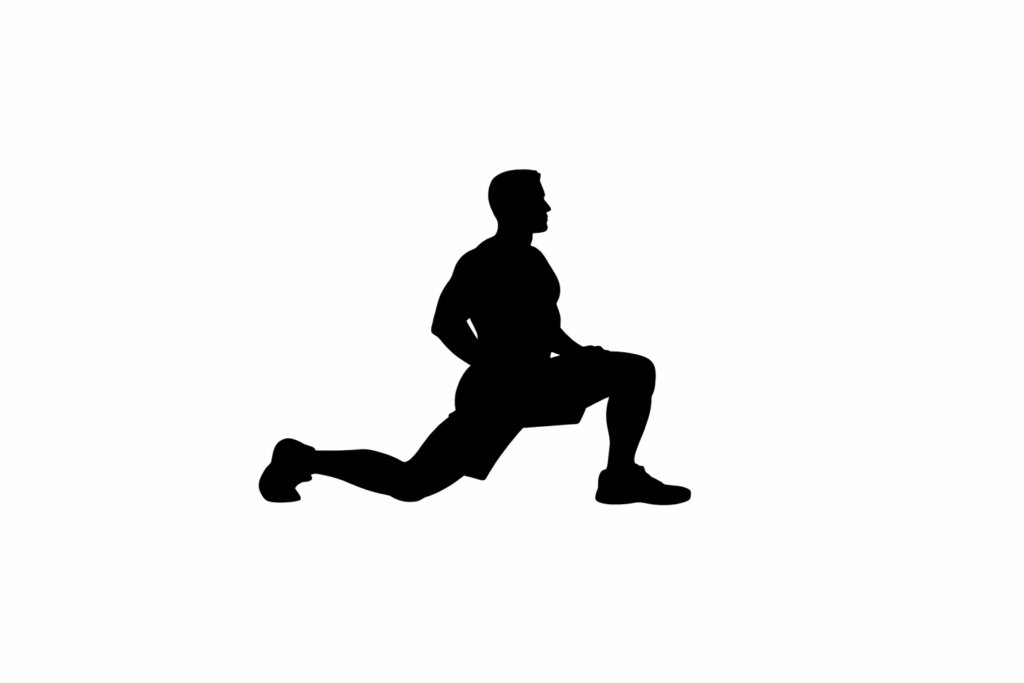
Here’s the truth: Most men stretch their hip flexors wrong. They crank into a lunge, arch their back, and stretch the wrong tissue.
The fix is a combination of:
- mobility
- activation
- posture correction
- stress reduction
- glute strengthening
Below is the exact sequence that works.
Step 1: Stop Overstretching the Hip Flexor
If you feel it in your lower back, you’re not stretching — you’re jamming your spine.
Correct stretch cues:
- tuck pelvis slightly
- squeeze glute on the back leg
- keep ribs down
- lean forward only a few inches
You should feel it deep in the front hip, not the back.
Step 2: Release the Psoas (The Right Way)
Option A: Floor Release
- Lie on your stomach
- Place a soft ball just inside your hip bone
- Relax and breathe for 60–90 seconds
This resets the psoas without forcing it.
Option B: Supported Bridge
- Lie on your back
- Place a block or pillow under your sacrum
- Let hips gently open
- Hold 1–2 minutes
This unloads the hip flexors and calms the nervous system.
Step 3: Restore Hip Mobility
Men over 40 need rotation more than stretching.
Two key drills:
- 90/90 hip rotations
- Hip CARs (controlled circles)
These restore the joint mechanics so the hip flexors stop compensating.
Step 4: Turn the Glutes Back On
This is the real fix.
When the glutes fire, the hip flexors finally get to relax.
Best glute activators:
- glute bridge
- clamshell
- lateral band walk
- single‑leg hinge pattern
2–3 minutes a day changes everything.
Step 5: Fix Your Pelvis Position
If your pelvis is tilted forward (most men 40+), your hip flexors stay locked.
Quick reset:
- stand tall
- squeeze glutes
- exhale fully
- ribs down
- slight tuck
This puts the hip flexors back in a neutral length.
Step 6: Reduce Stress Load
The psoas is a fight‑or‑flight muscle.
High stress = tight psoas = hip flexor pain.
Simple daily resets:
- long exhale breathing
- walking
- mobility loop
- your “stress killer” routine
This is where your stress cluster interlinks perfectly.
When to See a Professional
If pain is:
- sharp
- radiating
- causing numbness
- affecting sleep
- worsening over weeks
…a healthcare professional should evaluate it to rule out nerve or joint issues.
The Bottom Line
Hip flexor pain in men over 40 isn’t random. It’s a predictable pattern caused by:
- sitting
- stress
- weak glutes
- stiff hips
- old injuries
- pelvic floor tension
Fix the chain, and the pain goes away.
This content is for general information only. It’s not medical advice, and it’s not a substitute for talking with a qualified health professional.